I have been building hands-on cybersecurity exercises for years without a good name for what I was designing. Lab development, course design, and content named the artifact. None of them named what happens in a student's head between opening an exercise and submitting an answer. IDET 6315 gave me the name.
What LXD is, and how the process runs
North (2023) defines learning experience design as "a way of creating learning experiences that focus on the content and the context of the system" (p. 13). A manager wanted a slide deck on product defects assigned to everyone. The designer found that lighting in the inspection area made the defects hard to see (pp. 2-3). No slide deck fixes lighting, which is why research and needs assessment sit in her core capability model (p. 5). Schmidt and Huang (2022) tighten the definition after coding 15 practitioner chapters: LXD is human-centric, theoretically grounded, and socio-culturally sensitive, aimed at identified goals and informed by user-experience methods. They also split LXD, the design practice, from learner experience, the quality a person perceives. I had been using those phrases as synonyms. Floor (2023) supplies the instruments: the Learning Experience Canvas, personas, empathy maps, and a loop of question, research, design, develop, test, and launch. The shared move is the one that reframes my courses. Design the experience, not the artifact.
North (2023, Chapter 2) maps a process that will look familiar to anyone who has used ADDIE, with the emphasis moved. Task analysis goes after what the learner actually does at work. Assessment is a design problem. Usability testing gets applied to the product. The process closes by messaging why the experience exists, the step I have skipped. Chapter 3 turns the front of that into request, kickoff, and scope, guided by "Who is doing what by when?" (p. 10). ATD project management and ISTE Education Leaders 3.2.a meet in that one line: name the milestone, and bring in more than my own perspective (Association for Talent Development, n.d.; International Society for Technology in Education, 2018). My request is not more labs. It is a performance problem. Students can follow a walkthrough and still freeze when the path is underspecified.
Three based-learning types I build with
The "based" is the organizing structure of the experience. Problem-based learning withholds some information. Project-based learning organizes work around a deliverable. Challenge-based learning withholds the solution (Gandini & Morselli, 2026). Game-based learning adds rules, scoring, and a defined end (Plass et al., 2015). Scenario-based learning withholds the verdict until the student commits (Chernikova et al., 2020). I keep the last three in circulation on the Open Cyber Range and in the capture-the-flag events I run with it.
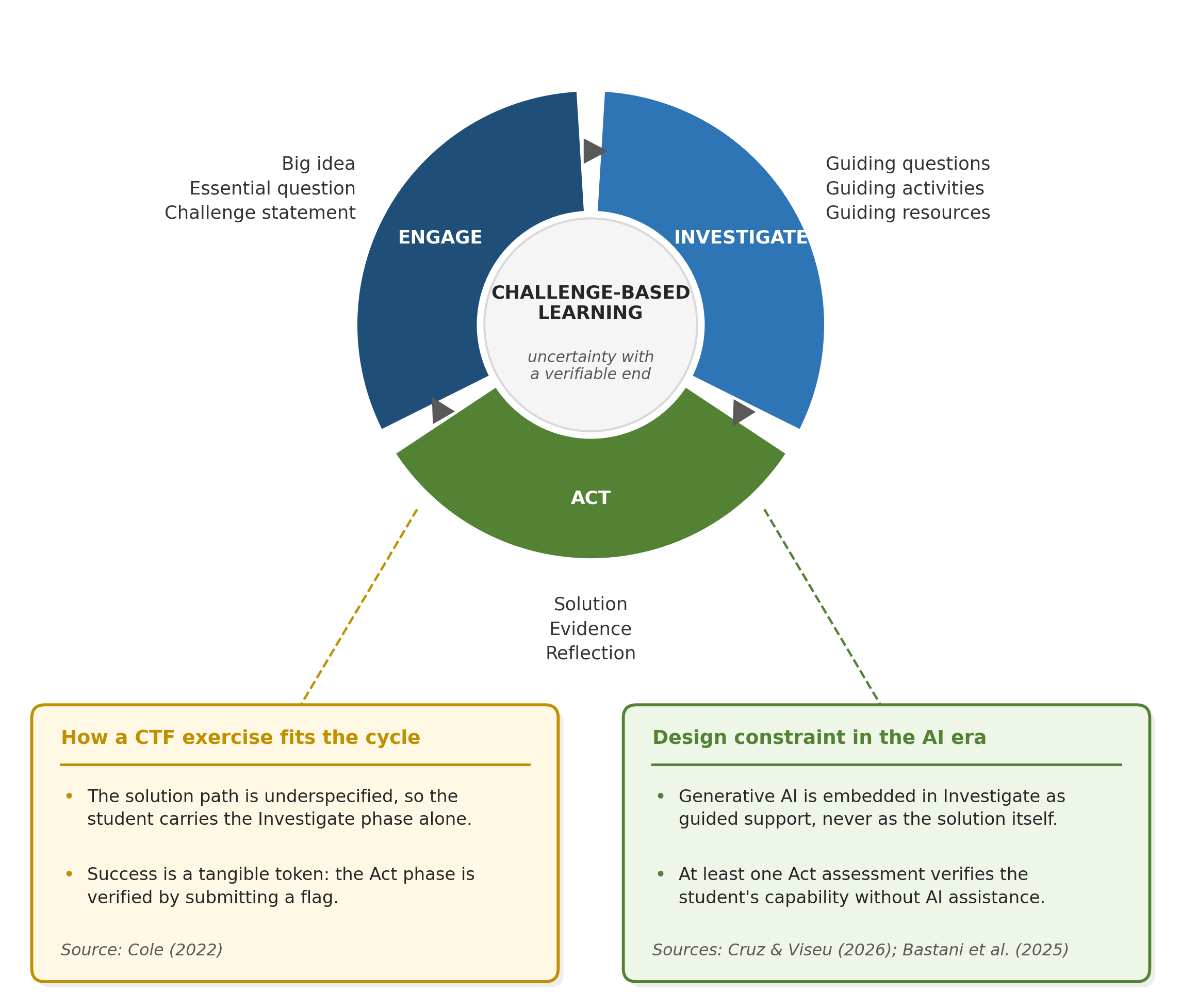
Figure 1. Challenge-based learning cycle with cyber-range challenge characteristics and an AI-era design constraint. Note. Adapted from the engage, investigate, act framework as applied by Cruz and Viseu (2026) and the exercise characteristics identified by Cole (2022). Figure created by author.
Challenge-based learning
Challenge-based learning puts students in front of an open problem, has them investigate it, and asks them to act (Cruz & Viseu, 2026). Gandini and Morselli (2026) locate the split from problem-based learning: "the main distinction between problem-based learning and CBL lies in the degree of uncertainty" (p. 2). A challenge has no predetermined solution.
Case scenario. A student opens a range exercise on a compromised host. No walkthrough. The brief states the situation and the objective. Success is a flag. Cole (2022) reduces the form to "an underspecified solution path and a tangible token of success" (p. 470) and found higher motivation than walkthroughs, with no exam-score cost.
Game-based learning
Plass et al. (2015) treat game-based learning as play with defined learning outcomes, not points hung on a dull worksheet. The loop is a challenge, a response, and feedback.
Case scenario. A team event runs on a clock with tiered points. Students triage what is worth attempting, a skill the untimed lab never touches. Schafeitel-Tähtinen and Lazarov (2025) found gains in knowledge, skill, self-efficacy, and interest, with the catch that "different types of students may benefit in different ways" (p. 15). I have watched the high-skill version locally. Students who wanted more practice than class allowed formed their own security group.
Scenario-based learning
Scenario-based learning puts a role and a consequence in front of the learner. Chernikova et al. (2020) found a large effect for simulation practice of complex skills (g = 0.85). North (2023, p. 3) lists scenario-based e-learning among the products of the manufacturing example.
Case scenario. A student takes an analyst role at a live alert queue, pivots from an entity to the evidence, and commits to a verdict. The commitment is the design. A student who never has to declare an answer never gets taught by being wrong.
Where AI sits, and what I am changing
IBSTPI asks whether the environment can support a technology and what it costs (Koszalka et al., 2013). Bastani et al. (2025) found unrestricted GPT-4 raised practice scores, then left students 17% worse once the tool was removed. A hint-only tutor removed most of the harm. Cruz and Viseu (2026) heard students say AI suggestions mean "it is necessary to pay attention" (p. 384). I added an AI Opportunities prompt to range exercises so the assistant can help without handing over the path. Final practicals stay AI-free so students can see the difference between being helped and being capable.
I have been a competent builder and an unexamined designer. North's map showed the gap: research is strong, needs assessment is what I skip when the semester tightens. Schmidt and Huang (2022) stopped me from using experience as a synonym for engagement. The concrete change is a project plan that names what students are measured on, what the experience withholds, and why it exists.
Gandini and Morselli (2026) found almost no student voice in CBL studies. The same hole is in the cybersecurity literature. Next I treat the reflection step I already assign as data, and test whether that AI placement rule holds when students describe what they did. The work sits against the module SLO on game-based and AI-enhanced environments, and against ATD, ISTE 3.2.a, and IBSTPI's technology analysis.
References
Association for Talent Development. (n.d.). Talent development capability model. https://td.org/capability-model
Bastani, H., Bastani, O., Sungu, A., Ge, H., Kabakcı, Ö., & Mariman, R. (2025). Generative AI without guardrails can harm learning: Evidence from high school mathematics. Proceedings of the National Academy of Sciences, 122(26), Article e2422633122. https://doi.org/10.1073/pnas.2422633122
Chernikova, O., Heitzmann, N., Stadler, M., Holzberger, D., Seidel, T., & Fischer, F. (2020). Simulation-based learning in higher education: A meta-analysis. Review of Educational Research, 90(4), 499-541. https://doi.org/10.3102/0034654320933544
Cole, S. V. (2022). Impact of Capture The Flag (CTF)-style vs. traditional exercises in an introductory computer security class. In Proceedings of the 27th ACM Conference on Innovation and Technology in Computer Science Education (ITiCSE 2022) (pp. 470-476). ACM. https://doi.org/10.1145/3502718.3524806
Cruz, S., & Viseu, F. (2026). The challenge-based education approach and generative AI tools in the development of digital skills. Journal of Turkish Science Education, 23(2), 371-394. https://doi.org/10.36681/tused.2026.018
Floor, N. (2023). This is learning experience design: What it is, how it works, and why it matters. New Riders.
Gandini, M. F., & Morselli, D. (2026). Challenge-based learning implementation in K-12 education: A systematic literature review. Frontiers in Education, 10, Article 1680347. https://doi.org/10.3389/feduc.2025.1680347
International Society for Technology in Education. (2018). ISTE standards for education leaders. https://iste.org/standards/education-leaders
Koszalka, T. A., Russ-Eft, D. F., & Reiser, R. (2013). Instructional designer competencies: The standards (4th ed.). Information Age.
North, C. (2023). Learning experience design essentials: Designing for users and impact. ATD Press.
Plass, J. L., Homer, B. D., & Kinzer, C. K. (2015). Foundations of game-based learning. Educational Psychologist, 50(4), 258-283. https://doi.org/10.1080/00461520.2015.1122533
Schafeitel-Tähtinen, T., & Lazarov, W. (2025). Teaching and learning cybersecurity using Capture the Flag: Effectiveness comparison between university students in Finland and Czechia. Computer Applications in Engineering Education, 33(5), Article e70082. https://doi.org/10.1002/cae.70082
Schmidt, M., & Huang, R. (2022). Defining learning experience design: Voices from the field of learning design & technology. TechTrends, 66(2), 141-158. https://doi.org/10.1007/s11528-021-00656-y