<?xml version="1.0" encoding="utf-8"?><feed xmlns="http://www.w3.org/2005/Atom" ><generator uri="https://jekyllrb.com/" version="3.10.0">Jekyll</generator><link href="https://youcanzerotrustme.com/feed.xml" rel="self" type="application/atom+xml" /><link href="https://youcanzerotrustme.com/" rel="alternate" type="text/html" /><updated>2026-11-09T07:26:31-06:00</updated><id>https://youcanzerotrustme.com/feed.xml</id><title type="html">youcanzerotrustme</title><subtitle>Research notes, build logs, and design reasoning from Lewis Heuermann.</subtitle><author><name>Lewis Heuermann</name></author><entry><title type="html">What Host Triage&apos;s Canvas module actually locks</title><link href="https://youcanzerotrustme.com/blog/2026/11/09/what-host-triages-canvas-module-actually-locks/" rel="alternate" type="text/html" title="What Host Triage&apos;s Canvas module actually locks" /><published>2026-11-09T00:00:00-06:00</published><updated>2026-11-09T00:00:00-06:00</updated><id>https://youcanzerotrustme.com/blog/2026/11/09/what-host-triages-canvas-module-actually-locks</id><content type="html" xml:base="https://youcanzerotrustme.com/blog/2026/11/09/what-host-triages-canvas-module-actually-locks/"><![CDATA[<p>Host Triage Scenario 1 still scores three artifacts: ordered host list, evidence note, handoff sentence. Practice stays on OpenCyberRange and the MkDocs workbook. The Module 5 change is the project-management surface. Module <em>Host Triage — Scenario 1</em> in COSC-3474-W21 (<code class="language-plaintext highlighter-rouge">courses/32605</code>, module unpublished) now carries push, pull, and the drop in this order:</p>

<ol>
  <li>Meets / Does not meet — Host Triage Scenario 1 (Page)</li>
  <li>Scenario brief — Host Triage Scenario 1 (Page)</li>
  <li>HOST_A teach example (Page)</li>
  <li>Pair-review script (90 seconds) (Page)</li>
  <li>Scenario 1 submit — order, evidence, handoff (Assignment <code class="language-plaintext highlighter-rouge">691266</code>)</li>
</ol>

<p>North's message-and-takeoff chapter is useful here because the first item is the criteria page, not the story (North, 2023, Chapter 9). Meets language on that page is human-locked and concrete:</p>

<ul>
  <li>Host list: first host needs a process, log, or network cue; one reason per host; max 12 words. Guess language ("looks weird") fails.</li>
  <li>Evidence note: max 120 words; must name one check performed and one skipped, with a time or priority reason.</li>
  <li>Handoff: max 40 words; next action must be doable by someone who was not in the room. "Investigate further" fails. Examples use HOST_A only. No live compromised host on the page.</li>
</ul>

<p>The teach Page walks that pattern on HOST_A / HOST_B placeholders (failed auth burst, unexpected process, lateral connection as signal shapes), then tells the learner to close it before the live reinforce run so the hint thins on purpose. That is the New moment. Pair-review is the More moment: partner gets 90 seconds for two questions only (signal that put the first host first; one skipped check and why); author gets 2 minutes to revise the evidence note; partner does not rewrite or score.</p>

<p>Push is three Canvas mechanisms, not a notification product. P1 is Meets-first module order. P2 is the assignment description checklist with a direct link to the Pair-review Page: partner asked both questions; I revised the evidence note once (or noted why not). P3 is the Canvas due date / To-do cue. Right now assignment <code class="language-plaintext highlighter-rouge">691266</code> still has <code class="language-plaintext highlighter-rouge">due_at = null</code>, so P3 is designed and not yet armed. Pull is the four in-module opens: pair-review script, scenario brief, HOST_A teach, and the linear DOCX packet linked from the assignment when the module UI is the barrier. I rejected Trello, a separate FAQ, and a Drive-wide agent connector. An agent may draft Page copy. It does not paste Meets rows and does not get whole-Drive access.</p>

<p>For results, North separates how the hour felt from what the work shows (North, 2023, Chapter 10). My evidence so far is an instructor walkthrough of the unpublished module and a 1:04 screencast, not a student cohort survey. In that pass the four Pages render and the assignment text carries the P2 checklist, but the pair step remains skippable because nothing in Canvas yet requires the confirmation. The data signals I will watch after a real run are blunt: Meets opened before submit or not; checklist ignored or not; submission names a live host instead of HOST_A; linear DOCX never opened. Explore / Save / Apply for this cycle: I explored Trello, FAQ, outside reminders, Drive-wide connectors, and naming a live host in the teach example. I saved Meets-first order, the 12/120/40 limits, HOST_A-only examples, the 90-second script, and Canvas as the only board. Apply 1 is the shipped support pair on items 4 and 5: checklist push into the Pair-review Page pull.</p>

<p>The evaluation-template habit that stayed is the same binary on the evidence note (check done + check skipped), not a smile sheet about the lab. Next technical test is whether arming <code class="language-plaintext highlighter-rouge">due_at</code> and adding an ungraded pair confirmation (or a SpeedGrader note) raises revised notes without adding a tool outside Canvas.</p>

<h2 id="references">References</h2>

<p>Clark, D. (2022). <em>Learning experience design: How to create effective learning that works</em>. Kogan Page.</p>

<p>North, C. (2023). <em>Learning experience design essentials: Designing for users and impact</em>. ATD Press.</p>

<p>Anthropic's Claude Code was used as a thought partner for code and grammar reviews.</p>]]></content><author><name>Lewis Heuermann</name></author><category term="Research Notes" /><category term="lxd" /><category term="phd" /><category term="instructional-design" /><category term="host-triage" /><category term="canvas" /><summary type="html"><![CDATA[IDET 6315 Blog 5: Host Triage Scenario 1 module order, Meets limits, pair-review protocol, and the Canvas support pair that replaced Trello.]]></summary></entry><entry><title type="html">Quality check before the next build</title><link href="https://youcanzerotrustme.com/blog/2026/10/23/quality-check-before-the-next-build/" rel="alternate" type="text/html" title="Quality check before the next build" /><published>2026-10-23T00:00:00-05:00</published><updated>2026-10-23T00:00:00-05:00</updated><id>https://youcanzerotrustme.com/blog/2026/10/23/quality-check-before-the-next-build</id><content type="html" xml:base="https://youcanzerotrustme.com/blog/2026/10/23/quality-check-before-the-next-build/"><![CDATA[<p>I've already got a scenario, a Trello board, and the three things I grade: an ordered host list, a short evidence note, and a handoff sentence. The reading this week was a check on that draft before I add another tool. I went through Clark's later chapters and North's quality-check chapter against the work I already have.</p>

<h2 id="what-i-checked-on-the-lab">What I checked on the lab</h2>

<p>A first-year student usually misses this lab by grabbing the wrong host or skipping a log. Clark's chapter on engagement, questions, and feedback is about making the student do that work (Clark, 2022, Chapter 8). In the pair script the partner asks two things: which signal put the first host first, and which check got skipped. The partner leaves the order alone. If the partner rewrites the list, I would be grading the partner's triage, and the owner's note would never have to show the checks.</p>

<p>The simulation stays the Open Cyber Range scenario (Clark, 2022, Chapter 9). Students get a small network, hosts that fail in different ways, and a 40-minute clock in the reinforce stage. I read the VR and AR chapter and left it (Clark, 2022, Chapter 10). These students already run the lab at night on a laptop, and a headset would not change which host they open first. The score stays Meets or does not meet on the three artifacts (Clark, 2022, Chapter 11). A point total could let a fast list pass when the note is thin.</p>

<p>I kept the social part small (Clark, 2022, Chapter 12). During the section, two students review the list for about 90 seconds. After the section, one brief goes to a person outside the class: a campus SOC student worker, a local tabletop partner, or a mentor for a high-school cyber club. The brief names who it is for, what I am asking, and why. It leaves out the lab answer. If that person writes back, the reply is one question to me. I grade the students.</p>

<p>Transfer is the part I planned most carefully (Clark, 2022, Chapter 13). Teach, reinforce, and challenge all ask for the same three products. The first pass includes a hint card. The next pass takes the card out. A later pass adds a false-lead host and noisier logs. I am keeping those three products the same while the scenario gets harder, so a later pass is still the same judgment with less help.</p>

<h2 id="the-pass-i-have-not-run">The pass I have not run</h2>

<p>Chapter 8 of North is the quality check before students see a lab. She titles it "The Red Pen," after the pen an editor uses to mark mistakes on a draft (North, 2023, Chapter 8). She describes five checks. A teammate reads the materials. I compare them with the rules I already wrote. I look for mistakes. Someone who did not build the lab reads it. Then I test whether a student can submit the work.</p>

<p>On Host Triage the rules are a word limit on each answer, and Meets or does not meet. The mistake I am most likely to leave in is a spoiler in the MkDocs brief, or a worked example that names the real host instead of HOST_A. I am the only designer on this lab, so those reads are mine. The outside read is the community brief from the section above: one person, one question back to me. I have not tested the hand-in. I still need to open the Canvas assignment and see whether a student can submit the host list, the evidence note, and the handoff sentence in three fields.</p>

<p>In that same chapter, North separates how students feel about the hour from what the work shows they can do (North, 2023, pp. 104-105). I am not asking them to rate the lab. The evidence note has to name one check they ran and one check they skipped, and I use that note when I score.</p>

<p>Clark's last chapter is about running the experience after the design is drafted (Clark, 2022, Chapter 14). My board in Trello is Backlog, Ready, Doing, Blocked, Done, and a community list. When a card is blocked, I write the owner and the reason on the card so I can see the delay the next time I open the board. The one-page brief is the piece I keep current. The records I keep are the three Canvas fields. I am not recording where students click.</p>

<p>Coursera this week was Module 1 of <a href="https://www.coursera.org/organizations/tamucc/learn/ai-tools-data-and-experience-design?authProvider=tamucc&amp;specialization=ai-powered-ui-ux-design#modules">AI Tools, Data, and Experience Design</a>, the module on AI tools for designers. The course lists 53 minutes, and I finished it, including Quiz 1. The Coursera learning log for this week lists each lesson and the limit I set for Host Triage. Those lessons can shape a screen or a prototype. They leave the brief, the pair script, and the three artifacts as they are. Before the November brief I will run North's quality check on the scenario brief and on the Canvas assignment. The Canvas fields are the part still open.</p>

<h2 id="references">References</h2>

<p>Clark, D. (2022). <em>Learning experience design: How to create effective learning that works</em>. Kogan Page.</p>

<p>North, C. (2023). <em>Learning experience design essentials: Designing for users and impact</em>. ATD Press.</p>

<p>Anthropic's Claude Code was used as a thought partner for code and grammar reviews.</p>]]></content><author><name>Lewis Heuermann</name></author><category term="Research Notes" /><category term="lxd" /><category term="phd" /><category term="instructional-design" /><category term="host-triage" /><summary type="html"><![CDATA[IDET 6315 check on Host Triage before the next build: Clark on effort, simulation, and transfer, and North's quality check I have not finished.]]></summary></entry><entry><title type="html">Based-learning module and LXD project management environment outlines</title><link href="https://youcanzerotrustme.com/blog/2026/10/15/based-learning-module-and-lxd-pm-outlines/" rel="alternate" type="text/html" title="Based-learning module and LXD project management environment outlines" /><published>2026-10-15T00:00:00-05:00</published><updated>2026-10-15T00:00:00-05:00</updated><id>https://youcanzerotrustme.com/blog/2026/10/15/based-learning-module-and-lxd-pm-outlines</id><content type="html" xml:base="https://youcanzerotrustme.com/blog/2026/10/15/based-learning-module-and-lxd-pm-outlines/"><![CDATA[<p>Host Triage is the based-learning module: a timed Open Cyber Range scenario where first-year cyber students practice triage judgment by producing an ordered host list, an evidence note, and a handoff sentence. The LXD project management environment is a Trello board that keeps Scenario 1 build work visible (brief, lab stub, workbook, Canvas drop, rubric, pair review) and adds a community outreach list so learners practice handoff language with an audience outside the lab section. I used a Custom GPT with hard rules (no rewriting success criteria, no spoilers, paste-ready cards) to draft both outlines, then edited them so the human lock on the three artifacts stayed intact.</p>

<h2 id="checklist-products">Checklist products</h2>

<p>The Word artifacts for this midterm (Custom GPT instructions, LLM prompts, PM outline, based-learning module outline, and exploratory tools list) are shared as individual Google Drive files with my Canvas midterm discussion post, same pattern as the rest of the class. Related rationale: <a href="/blog/2026/10/14/progressive-project-rationale-host-triage/">Progressive project rationale: Host Triage</a>.</p>

<h2 id="how-i-got-here">How I got here</h2>

<p>The first Custom GPT pass tried to add extra soft-skill goals. I cut those. Triage judgment is the goal; coaching and community practice support it. The PM board stayed Trello-first because the card metaphor matches how I already track OCR lab work. Asana stays on the tools list as the alternate if a partner team already lives there. The community card is intentionally small: pick an audience, draft a short handoff brief, track the reply. Scenario 1 does not wait on an external calendar.</p>

<p>Anthropic's Claude Code was used as a thought partner for code and grammar reviews.</p>]]></content><author><name>Lewis Heuermann</name></author><category term="Research Notes" /><category term="lxd" /><category term="progressive-project" /><category term="phd" /><category term="instructional-design" /><category term="host-triage" /><category term="midterm" /><summary type="html"><![CDATA[IDET 6315 midterm vision for Host Triage: Custom GPT prompts, Trello-ready PM board outline, Scenario 1 module outline, and the tool options I am keeping or parking.]]></summary></entry><entry><title type="html">Progressive project rationale: Host Triage</title><link href="https://youcanzerotrustme.com/blog/2026/10/14/progressive-project-rationale-host-triage/" rel="alternate" type="text/html" title="Progressive project rationale: Host Triage" /><published>2026-10-14T00:00:00-05:00</published><updated>2026-10-14T00:00:00-05:00</updated><id>https://youcanzerotrustme.com/blog/2026/10/14/progressive-project-rationale-host-triage</id><content type="html" xml:base="https://youcanzerotrustme.com/blog/2026/10/14/progressive-project-rationale-host-triage/"><![CDATA[<p>I built Host Triage as a progressive project because the learning problem itself unfolds in stages. A first-year cyber student rarely fails triage by missing a definition. They fail by grabbing the wrong host first, skipping a log, or treating every alert like it matters equally. That is a judgment problem under time pressure. A quiz on "what is triage" does not catch it. A short Open Cyber Range scenario that forces them to pick an order, leave a trail, and say why does.</p>

<p>Module 4's readings and the ATD capability model gave me language for decisions I was already making by feel. What follows is the rationale: what the project is trying to do, which standards it touches, and how the Module 4 sources shaped the next cut.</p>

<h2 id="what-host-triage-is-for">What Host Triage is for</h2>

<p>Host Triage sits inside Cyber Defense I as Scenario 1 on the Open Cyber Range. Students get a small network, a handful of hosts that look differently wrong, and a clock. The job is not "find every IOC." The job is: decide where to look first, collect just enough evidence, and hand off a clean story to whoever comes next. That maps to real SOC and IR work more honestly than a worksheet that asks for the definition of PPP.</p>

<p>I am treating it as progressive work in the sense Glaser and colleagues describe when they unpack design considerations across learner, tech, and pedagogy layers (Glaser et al., 2023). Students move through stages of the same problem with more ambiguity each time, not through disconnected topics. Early on they might name the host that looks most wrong. Later passes add log noise, a dead-end lead, and a write-up that has to survive a peer review. Same scenario family. Harder judgment.</p>

<h2 id="atd-and-the-standards-i-am-actually-using">ATD and the standards I am actually using</h2>

<p>I am not mapping every letter of every framework. I am using three ATD layers the way they show up in this lab, plus the Module 4 standards that ask for project scope, planning tools, and collaborative feedback culture (Association for Talent Development, n.d.).</p>

<p><strong>Personal.</strong> Curiosity and learning agility matter here more than tool fluency. Students who treat triage as a checklist get stuck when the obvious host is clean. The personal capability I want visible is: stay with the problem when the first guess fails. That shows up in the reflection prompt after the scenario, not in a multiple-choice item about curiosity.</p>

<p><strong>Professional.</strong> Instructional design and learning technologies are the professional lane I am working in. Coaching shows up as the paired pressure-test in the reinforce stage: one student owns the host order, the other asks hard questions about the evidence note. The OCR lab, the MkDocs workbook, and the Canvas checkpoint are the delivery surface. Assessment design keeps the scenario from becoming theater. Students produce an ordered host list, a short evidence note, and a handoff sentence. Those artifacts are what I score.</p>

<p><strong>Organizational.</strong> Change management and culture-of-feedback sit one level up. Host Triage only earns its keep if the rest of the cyber sequence can reuse the same judgment pattern: alert, prioritize, evidence, handoff. I am writing it so Scenario 2 can inherit the same rubric language instead of inventing a new one. The project-management board is where that culture gets practiced: students see scope, blockers, and feedback as part of the work, not as a separate "soft skills" unit.</p>

<p>On accessibility I am staying with the WCAG / POUR checklist from Module 3. Module 4 does not get a new compliance layer. The progressive project should not quietly undo that work.</p>

<h2 id="inquiry-questions-that-drove-the-read">Inquiry questions that drove the read</h2>

<p>Before I went deep on the PDFs I wrote four questions tied to the Module 4 standards:</p>

<ol>
  <li>How do I keep Host Triage progressive without turning every week into a new unit?</li>
  <li>Where does partnership or coaching belong inside a solo-looking triage lab?</li>
  <li>How should AI assist my design work without rewriting what "good triage" means?</li>
  <li>What planning surface lets learners practice community-facing outcomes while I still ship Scenario 1 on time?</li>
</ol>

<p>Those questions framed the notes below.</p>

<h2 id="how-the-module-4-readings-moved-the-design">How the Module 4 readings moved the design</h2>

<p><strong>Schmidt, Earnshaw, Jahnke, and colleagues (2024) on entangled eclecticism.</strong> Their sociotechnical-pedagogical systems framing matches how Host Triage actually gets built. Pedagogy (judgment under time pressure), tech (OCR + MkDocs + Canvas), and social context (pair review, later community outreach via the PM board) are tangled on purpose. I am not picking one theory and forcing the lab to wear it. I am naming the tangle and keeping each layer visible in the artifacts.</p>

<p><strong>Glaser, Thull, Schmidt, and colleagues (2023) on LXD design considerations.</strong> Even though their review focuses on spherical video VR for autistic learners, the move I stole is the explicit unpack of sociocultural, technological, and pedagogical considerations. For Host Triage that means: sociocultural = pair pressure-test and eventual community handoff language; technological = OCR as the live surface, MkDocs as the brief, Canvas as the gradeable drop; pedagogical = thinning scaffolds on the same triage skill. Progressive design here means the hint about which signal usually matters disappears in later passes. The core skill stays.</p>

<p><strong>Lin, Garcia, Nasir, and Sultana (2024) on ChatGPT for project-management dynamics.</strong> Their SITE paper is about simulating PM and software-development dynamics in online higher education. I am not putting students into a fake Scrum theater. I am using the same idea: a project-management environment where roles, tasks, and feedback are visible. For Host Triage, the LXD PM board (Trello first, with Asana as a backup option) is where Scenario 1 development work lives, and where a community-outreach card tracks how learners practice handoff language with an external audience (for example, a short brief for a campus SOC student worker or a local ISAC-style tabletop partner). The Custom GPT prompt for that board is built to keep it honest: scope, blockers, and community touchpoints stay on the board, not only in my head.</p>

<p><strong>Sakulviriyakitkul, Sintanakul, and Srisomphan (2020) on project-based learning and Agile teamwork.</strong> Their design for promoting teamwork with PBL and Agile concepts pushed me to put an explicit collaboration beat inside Host Triage. The reinforce stage now includes a short paired review. One student owns the order; the other pressure-tests the evidence note. That is Agile-flavored feedback without forcing a full sprint ceremony onto a 75-minute lab.</p>

<p><strong>Nilmanee, Sintanakul, and Sakulviriyakitkul (2024) on an LXP with xAPI and design thinking.</strong> The useful takeaway for me was the reminder that experience platforms drift unless the learning loop is designed. Host Triage already spans OCR, MkDocs, Canvas, Drive, and Figma. My rule for the progressive project: one source of truth for the scenario brief (MkDocs), one place for the gradeable artifact (Canvas), one place for the live environment (OCR). The PM board tracks work. Everything else is support. Design-thinking language shows up in how I frame the midterm outlines: empathize with the first-year learner under alert load, define the triage judgment problem, prototype the three artifacts, test with a peer pressure-test.</p>

<h2 id="what-i-am-not-claiming">What I am not claiming</h2>

<p>I am not claiming Host Triage is finished. The midterm work right now is about prompts and outlines so I can keep building without starting over every Sunday. I am also not claiming the ATD model replaces TAMU-CC outcomes. It is a lens. Where it helps me name a gap, like the missing partnership beat in an early draft, I use it. Where it would force a fake mapping, I leave it alone.</p>

<h2 id="next-cut">Next cut</h2>

<p>Aligned assessments lock the three artifacts (order, evidence note, handoff) to observable criteria. The midterm package locks a Custom GPT prompt and two outlines so the progressive project has a project-management spine. This post is the why. The rest of the packet is the how.</p>

<h2 id="references">References</h2>

<p>Association for Talent Development. (n.d.). <em>Talent development capability model</em>. https://td.org/capability-model</p>

<p>Glaser, N., Thull, C., Schmidt, M., et al. (2023). Learning experience design and unpacking sociocultural, technological, and pedagogical design considerations of spherical video-based virtual reality systems for autistic learners: A systematic literature review. <em>Journal of Autism and Developmental Disorders</em>. https://doi.org/10.1007/s10803-023-06168-3</p>

<p>Lin, W., Garcia, M., Nasir, M., &amp; Sultana, A. (2024). Beyond traditional teams: Using ChatGPT to simulate project management dynamics and software development in online higher education. In J. Cohen &amp; G. Solano (Eds.), <em>Proceedings of SITE 2024</em> (pp. 2123-2129). AACE. https://www.learntechlib.org/primary/p/224269/</p>

<p>Nilmanee, T., Sintanakul, K., &amp; Sakulviriyakitkul, P. (2024). The design of a learning experience platform using xAPI with design thinking learning to promote innovation. <em>International Journal of Emerging Technologies in Learning (iJET), 19</em>(1), 54-67. https://www.learntechlib.org/p/224939/</p>

<p>Sakulviriyakitkul, P., Sintanakul, K., &amp; Srisomphan, J. (2020). The design of a learning process for promoting teamwork using project-based learning and the concept of Agile software development. <em>International Journal of Emerging Technologies in Learning (iJET), 15</em>(3), 207-222. https://www.learntechlib.org/p/217016/</p>

<p>Schmidt, M., Earnshaw, Y., Jahnke, I., et al. (2024). Entangled eclecticism: A sociotechnical-pedagogical systems theory approach to learning experience design. <em>Educational Technology Research and Development, 72</em>, 1483-1505. https://doi.org/10.1007/s11423-024-10353-1</p>

<p>Anthropic's Claude Code was used as a thought partner for code and grammar reviews.</p>]]></content><author><name>Lewis Heuermann</name></author><category term="Research Notes" /><category term="lxd" /><category term="progressive-project" /><category term="phd" /><category term="instructional-design" /><category term="host-triage" /><summary type="html"><![CDATA[Module 4 notes on why Host Triage is a progressive project, how ATD and the Mod 4 readings shaped the next cut, and what stays locked as success criteria.]]></summary></entry><entry><title type="html">When the only tutor is AI: choosing a tool for host-triage scenarios</title><link href="https://youcanzerotrustme.com/blog/2026/09/29/when-the-only-tutor-is-ai/" rel="alternate" type="text/html" title="When the only tutor is AI: choosing a tool for host-triage scenarios" /><published>2026-09-29T00:00:00-05:00</published><updated>2026-09-29T00:00:00-05:00</updated><id>https://youcanzerotrustme.com/blog/2026/09/29/when-the-only-tutor-is-ai</id><content type="html" xml:base="https://youcanzerotrustme.com/blog/2026/09/29/when-the-only-tutor-is-ai/"><![CDATA[<p>Most of my Cyber Defense 1 students finish guided labs cleanly and still stall when a Linux host "is behaving oddly" and the next command is not on the page. The progressive project for IDET 6315 is that stall, narrowed to one unit: Challenge-Based Defense Scenarios on the Open Cyber Range. The learners are working adults in a hybrid section. They do a lot of the work alone, on a laptop over WireGuard, in an evening block that rarely gives them more than an hour.</p>

<h2 id="what-north-forced-me-to-lock-before-i-shopped-for-tools">What North forced me to lock before I shopped for tools</h2>

<p>North's Chapter 3 framing of request, kickoff, and scope stopped me from writing "add AI" as the request (North, 2023). The request is the freeze itself. Faced with signs of compromise or misconfiguration and no step list, a student has to decide what to check, when the evidence is enough, and what to change without taking the host down. Cathy Moore's "Will training help?" flowchart pointed the same direction: instruction earns its keep on the diagnostic sequence under fading support, not on another command reference (Moore, n.d.). The job aid, range self-check, published rubric, and AI-use protocol already carry part of that load.</p>

<p>Chapter 4 is where the work turned into a cognitive task analysis instead of a longer lab sheet. Host triage is the high-value task. The sequence I care about is mostly judgment: state the question, get a baseline, read processes and network state, check persistence and accounts, decide, contain, verify, then write a justification in 200 words or fewer. What actually drives the technology choice is when the work happens. On asynchronous nights there is no instructor in the room, and generative AI is often the only thing students can ask. I still grade the whole sequence across four scenarios. They need one evening that ends without feeling they broke the machine. A chat window that hands them the persistence path makes that gap worse. A partner that keeps them inside the triage order might not.</p>

<h2 id="two-candidates-one-primary">Two candidates, one primary</h2>

<p>Module 3 wants an emerging-technology analysis. Students already work on live hosts in the Open Cyber Range, so I am not adding another simulation platform. I looked at ChatGPT Edu and at Canvas IgniteAI.</p>

<p>With Edu I can lock the model to the scenario brief, the one-page triage job aid, and the AI-use protocol. IgniteAI is the AI already built into Canvas, where students open announcements, files, and drops. That can help while they are studying course materials. It does not help much when they are alone on the range host at night and do not know what to check next.</p>

<p>I am going with ChatGPT Edu. Canvas still holds the brief, the protocol, the rubric, and the justification drop. In Scenario 1 the student attaches only the job aid and the brief, asks what category of evidence to gather next, and is told not to ask for the exact persistence path. The justification has to say which suggestion they used, which they ignored, and what the range actually showed. That is ATD Technology Literacy I can defend: the tool is part of the work, not a feature list (Association for Talent Development, n.d.). ISTE Visionary Planner work asks the same question I ask before I buy anything: does this solve a named need, or am I buying it because it is new (International Society for Technology in Education, 2018). IBSTPI still wants the boring answers on cost, access, and whether the environment can support the tool (Koszalka et al., 2013). I do not have those answers yet, so they stay labeled as assumptions until licensing and student devices are checked.</p>

<h2 id="what-this-changes">What this changes</h2>

<p>Blog 1 left me with an AI Opportunities prompt and AI-free finals. Module 3 Week 1 makes the rule tighter. What is new here is not the range and not an LMS study chatbot. It is a constrained partner that can coach categories and cannot hand over the path. Bastani et al. (2025) already showed what unrestricted practice help can do to later performance; I would rather not rediscover that in my own section. The AI-use notes and the short justification become the window I get when I am not there. Gandini and Morselli (2026) found almost no student voice in challenge-based learning studies, and cybersecurity has the same hole. After Scenario 1 I need those voices before I claim the tool helps.</p>

<h2 id="references">References</h2>

<p>Association for Talent Development. (n.d.). <em>Talent development capability model</em>. https://td.org/capability-model</p>

<p>Bastani, H., Bastani, O., Sungu, A., Ge, H., Kabakcı, Ö., &amp; Mariman, R. (2025). Generative AI without guardrails can harm learning: Evidence from high school mathematics. <em>Proceedings of the National Academy of Sciences, 122</em>(26), Article e2422633122. https://doi.org/10.1073/pnas.2422633122</p>

<p>Gandini, M. F., &amp; Morselli, D. (2026). Challenge-based learning implementation in K-12 education: A systematic literature review. <em>Frontiers in Education, 10</em>, Article 1680347. https://doi.org/10.3389/feduc.2025.1680347</p>

<p>International Society for Technology in Education. (2018). <em>ISTE standards for education leaders</em>. https://iste.org/standards/education-leaders</p>

<p>Koszalka, T. A., Russ-Eft, D. F., &amp; Reiser, R. (2013). <em>Instructional designer competencies: The standards</em> (4th ed.). Information Age.</p>

<p>Moore, C. (n.d.). <em>Will training help?</em> https://blog.cathy-moore.com/will-training-help/</p>

<p>North, C. (2023). <em>Learning experience design essentials: Designing for users and impact</em>. ATD Press.</p>

<p>Anthropic's Claude Code was used as a thought partner for code and grammar reviews.</p>]]></content><author><name>Lewis Heuermann</name></author><category term="Research Notes" /><category term="lxd" /><category term="emerging-technology" /><category term="phd" /><category term="instructional-design" /><category term="ai" /><summary type="html"><![CDATA[Module 3 notes on scoping the Cyber Defense 1 host-triage unit, then weighing two emerging tools against the night-shift reality of hybrid learners.]]></summary></entry><entry><title type="html">Designing for uncertainty: LXD and three based-learning types I build with</title><link href="https://youcanzerotrustme.com/blog/2026/09/12/designing-for-uncertainty/" rel="alternate" type="text/html" title="Designing for uncertainty: LXD and three based-learning types I build with" /><published>2026-09-12T00:00:00-05:00</published><updated>2026-09-12T00:00:00-05:00</updated><id>https://youcanzerotrustme.com/blog/2026/09/12/designing-for-uncertainty</id><content type="html" xml:base="https://youcanzerotrustme.com/blog/2026/09/12/designing-for-uncertainty/"><![CDATA[<p>I have been building hands-on cybersecurity exercises for years without a good name for what I was designing. Lab development, course design, and content named the artifact. None of them named what happens in a student's head between opening an exercise and submitting an answer. IDET 6315 gave me the name.</p>

<h2 id="what-lxd-is-and-how-the-process-runs">What LXD is, and how the process runs</h2>

<p>North (2023) defines learning experience design as "a way of creating learning experiences that focus on the content and the context of the system" (p. 13). A manager wanted a slide deck on product defects assigned to everyone. The designer found that lighting in the inspection area made the defects hard to see (pp. 2-3). No slide deck fixes lighting, which is why research and needs assessment sit in her core capability model (p. 5). Schmidt and Huang (2022) tighten the definition after coding 15 practitioner chapters: LXD is human-centric, theoretically grounded, and socio-culturally sensitive, aimed at identified goals and informed by user-experience methods. They also split LXD, the design practice, from learner experience, the quality a person perceives. I had been using those phrases as synonyms. Floor (2023) supplies the instruments: the Learning Experience Canvas, personas, empathy maps, and a loop of question, research, design, develop, test, and launch. The shared move is the one that reframes my courses. Design the experience, not the artifact.</p>

<p>North (2023, Chapter 2) maps a process that will look familiar to anyone who has used ADDIE, with the emphasis moved. Task analysis goes after what the learner actually does at work. Assessment is a design problem. Usability testing gets applied to the product. The process closes by messaging why the experience exists, the step I have skipped. Chapter 3 turns the front of that into request, kickoff, and scope, guided by "Who is doing what by when?" (p. 10). ATD project management and ISTE Education Leaders 3.2.a meet in that one line: name the milestone, and bring in more than my own perspective (Association for Talent Development, n.d.; International Society for Technology in Education, 2018). My request is not more labs. It is a performance problem. Students can follow a walkthrough and still freeze when the path is underspecified.</p>

<h2 id="three-based-learning-types-i-build-with">Three based-learning types I build with</h2>

<p>The "based" is the organizing structure of the experience. Problem-based learning withholds some information. Project-based learning organizes work around a deliverable. Challenge-based learning withholds the solution (Gandini &amp; Morselli, 2026). Game-based learning adds rules, scoring, and a defined end (Plass et al., 2015). Scenario-based learning withholds the verdict until the student commits (Chernikova et al., 2020). I keep the last three in circulation on the Open Cyber Range and in the capture-the-flag events I run with it.</p>

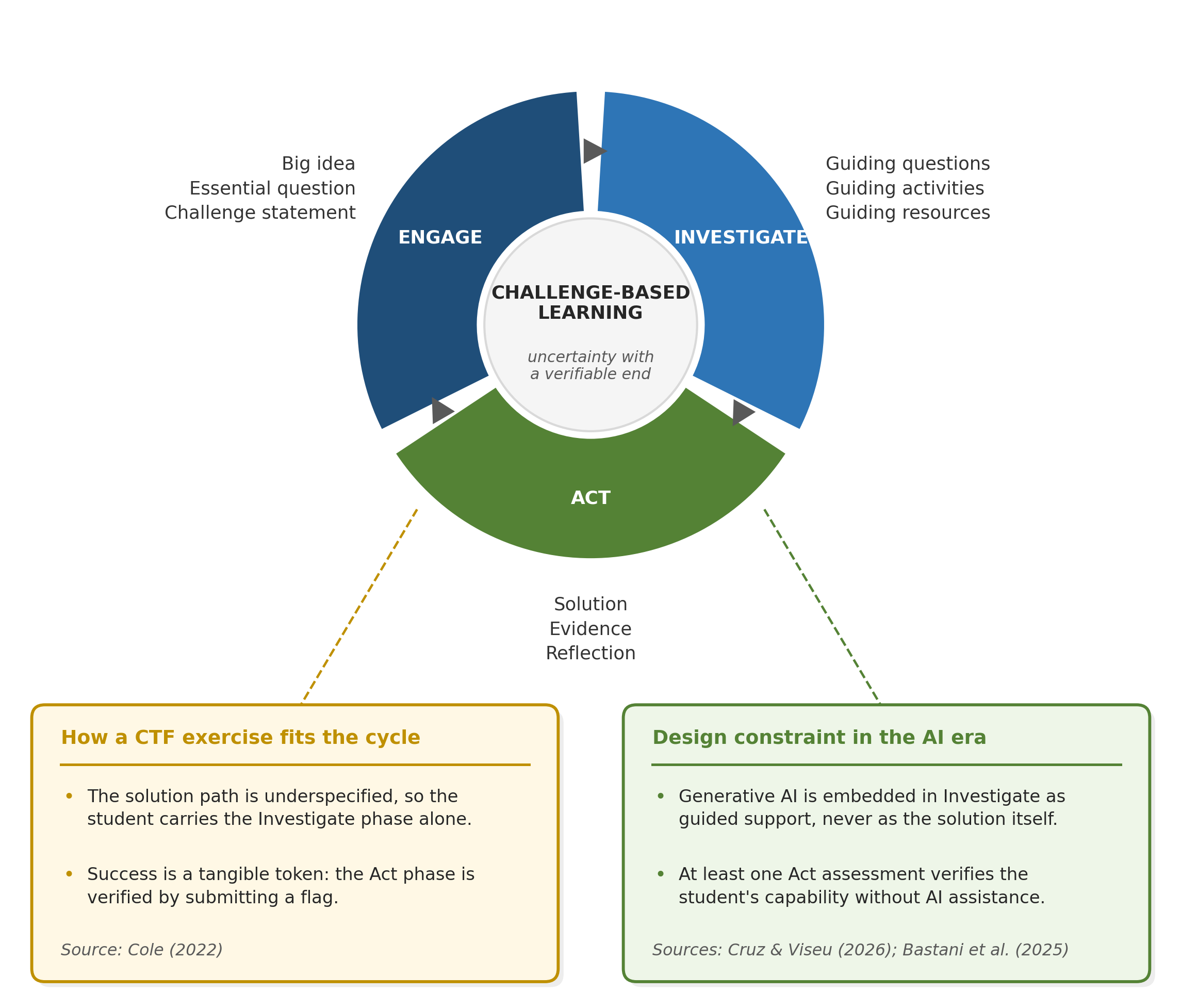
<p><img src="/images/cbl-cycle.png" alt="Challenge-based learning cycle with cyber-range challenge characteristics and an AI-era design constraint" /></p>

<p><em>Figure 1.</em> Challenge-based learning cycle with cyber-range challenge characteristics and an AI-era design constraint. Note. Adapted from the engage, investigate, act framework as applied by Cruz and Viseu (2026) and the exercise characteristics identified by Cole (2022). Figure created by author.</p>

<h3 id="challenge-based-learning">Challenge-based learning</h3>

<p>Challenge-based learning puts students in front of an open problem, has them investigate it, and asks them to act (Cruz &amp; Viseu, 2026). Gandini and Morselli (2026) locate the split from problem-based learning: "the main distinction between problem-based learning and CBL lies in the degree of uncertainty" (p. 2). A challenge has no predetermined solution.</p>

<p><em>Case scenario.</em> A student opens a range exercise on a compromised host. No walkthrough. The brief states the situation and the objective. Success is a flag. Cole (2022) reduces the form to "an underspecified solution path and a tangible token of success" (p. 470) and found higher motivation than walkthroughs, with no exam-score cost.</p>

<h3 id="game-based-learning">Game-based learning</h3>

<p>Plass et al. (2015) treat game-based learning as play with defined learning outcomes, not points hung on a dull worksheet. The loop is a challenge, a response, and feedback.</p>

<p><em>Case scenario.</em> A team event runs on a clock with tiered points. Students triage what is worth attempting, a skill the untimed lab never touches. Schafeitel-Tähtinen and Lazarov (2025) found gains in knowledge, skill, self-efficacy, and interest, with the catch that "different types of students may benefit in different ways" (p. 15). I have watched the high-skill version locally. Students who wanted more practice than class allowed formed their own security group.</p>

<h3 id="scenario-based-learning">Scenario-based learning</h3>

<p>Scenario-based learning puts a role and a consequence in front of the learner. Chernikova et al. (2020) found a large effect for simulation practice of complex skills (g = 0.85). North (2023, p. 3) lists scenario-based e-learning among the products of the manufacturing example.</p>

<p><em>Case scenario.</em> A student takes an analyst role at a live alert queue, pivots from an entity to the evidence, and commits to a verdict. The commitment is the design. A student who never has to declare an answer never gets taught by being wrong.</p>

<h2 id="where-ai-sits-and-what-i-am-changing">Where AI sits, and what I am changing</h2>

<p>IBSTPI asks whether the environment can support a technology and what it costs (Koszalka et al., 2013). Bastani et al. (2025) found unrestricted GPT-4 raised practice scores, then left students 17% worse once the tool was removed. A hint-only tutor removed most of the harm. Cruz and Viseu (2026) heard students say AI suggestions mean "it is necessary to pay attention" (p. 384). I added an AI Opportunities prompt to range exercises so the assistant can help without handing over the path. Final practicals stay AI-free so students can see the difference between being helped and being capable.</p>

<p>I have been a competent builder and an unexamined designer. North's map showed the gap: research is strong, needs assessment is what I skip when the semester tightens. Schmidt and Huang (2022) stopped me from using experience as a synonym for engagement. The concrete change is a project plan that names what students are measured on, what the experience withholds, and why it exists.</p>

<p>Gandini and Morselli (2026) found almost no student voice in CBL studies. The same hole is in the cybersecurity literature. Next I treat the reflection step I already assign as data, and test whether that AI placement rule holds when students describe what they did. The work sits against the module SLO on game-based and AI-enhanced environments, and against ATD, ISTE 3.2.a, and IBSTPI's technology analysis.</p>

<h2 id="references">References</h2>

<p>Association for Talent Development. (n.d.). <em>Talent development capability model</em>. https://td.org/capability-model</p>

<p>Bastani, H., Bastani, O., Sungu, A., Ge, H., Kabakcı, Ö., &amp; Mariman, R. (2025). Generative AI without guardrails can harm learning: Evidence from high school mathematics. <em>Proceedings of the National Academy of Sciences, 122</em>(26), Article e2422633122. https://doi.org/10.1073/pnas.2422633122</p>

<p>Chernikova, O., Heitzmann, N., Stadler, M., Holzberger, D., Seidel, T., &amp; Fischer, F. (2020). Simulation-based learning in higher education: A meta-analysis. <em>Review of Educational Research, 90</em>(4), 499-541. https://doi.org/10.3102/0034654320933544</p>

<p>Cole, S. V. (2022). Impact of Capture The Flag (CTF)-style vs. traditional exercises in an introductory computer security class. In <em>Proceedings of the 27th ACM Conference on Innovation and Technology in Computer Science Education (ITiCSE 2022)</em> (pp. 470-476). ACM. https://doi.org/10.1145/3502718.3524806</p>

<p>Cruz, S., &amp; Viseu, F. (2026). The challenge-based education approach and generative AI tools in the development of digital skills. <em>Journal of Turkish Science Education, 23</em>(2), 371-394. https://doi.org/10.36681/tused.2026.018</p>

<p>Floor, N. (2023). <em>This is learning experience design: What it is, how it works, and why it matters</em>. New Riders.</p>

<p>Gandini, M. F., &amp; Morselli, D. (2026). Challenge-based learning implementation in K-12 education: A systematic literature review. <em>Frontiers in Education, 10</em>, Article 1680347. https://doi.org/10.3389/feduc.2025.1680347</p>

<p>International Society for Technology in Education. (2018). <em>ISTE standards for education leaders</em>. https://iste.org/standards/education-leaders</p>

<p>Koszalka, T. A., Russ-Eft, D. F., &amp; Reiser, R. (2013). <em>Instructional designer competencies: The standards</em> (4th ed.). Information Age.</p>

<p>North, C. (2023). <em>Learning experience design essentials: Designing for users and impact</em>. ATD Press.</p>

<p>Plass, J. L., Homer, B. D., &amp; Kinzer, C. K. (2015). Foundations of game-based learning. <em>Educational Psychologist, 50</em>(4), 258-283. https://doi.org/10.1080/00461520.2015.1122533</p>

<p>Schafeitel-Tähtinen, T., &amp; Lazarov, W. (2025). Teaching and learning cybersecurity using Capture the Flag: Effectiveness comparison between university students in Finland and Czechia. <em>Computer Applications in Engineering Education, 33</em>(5), Article e70082. https://doi.org/10.1002/cae.70082</p>

<p>Schmidt, M., &amp; Huang, R. (2022). Defining learning experience design: Voices from the field of learning design &amp; technology. <em>TechTrends, 66</em>(2), 141-158. https://doi.org/10.1007/s11528-021-00656-y</p>

<p>Anthropic's Claude Code was used as a thought partner for code and grammar reviews.</p>]]></content><author><name>Lewis Heuermann</name></author><category term="Research Notes" /><category term="lxd" /><category term="challenge-based-learning" /><category term="phd" /><category term="instructional-design" /><summary type="html"><![CDATA[Learning experience design gave me a name for what I had been building without one. Notes on North, Schmidt, and Floor, and the three based-learning types I keep in circulation on the range.]]></summary></entry><entry><title type="html">What I&apos;ll Be Writing Here</title><link href="https://youcanzerotrustme.com/blog/2026/08/24/starting-a-build-log/" rel="alternate" type="text/html" title="What I&apos;ll Be Writing Here" /><published>2026-08-24T00:00:00-05:00</published><updated>2026-08-24T00:00:00-05:00</updated><id>https://youcanzerotrustme.com/blog/2026/08/24/starting-a-build-log</id><content type="html" xml:base="https://youcanzerotrustme.com/blog/2026/08/24/starting-a-build-log/"><![CDATA[<p>I'm Lewis, and this is where I'll be thinking out loud for the next few years.</p>

<p>I teach cybersecurity at Texas A&amp;M University-Corpus Christi, and I just started a PhD in Curriculum and Instruction with a focus in Instructional Design and Educational Technology. I also built and run <a href="https://opencyberrange.com">Open Cyber Range</a>, the platform my courses use for their hands-on labs. My advisor suggested I write publicly as I go, and I loved the idea right away. So much doctoral work lives its whole life in drafts and committee meetings, and I'd rather share the good parts while they're still in motion.</p>

<p>Most of what I do leaves an artifact behind: a lab that resets cleanly, a course module that finally lands with students, a range topology that survives twenty people hitting it at once. What the artifacts never carry is the reasoning behind them. The constraint I was working around. The version that failed first. The tradeoff I took on purpose and would take again. Six months later I can't always reconstruct my own decisions, which tells me they were worth writing down while they were fresh.</p>

<p>So that's what lands here.</p>

<h2 id="what-i-plan-to-post">What I plan to post</h2>

<p>Build logs, mostly. What got built, what broke, and what I learned when it broke. The busted version is usually the better story, so it stays in.</p>

<p>Design notes, when the teaching side is what's interesting. Why an exercise is sequenced the way it is, where the environment does the instructing instead of me, and how I work out whether a design actually did its job.</p>

<p>Research notes as the program picks up. Reading, methods, and the questions I haven't answered yet. I'd rather think out loud while I'm still figuring something out than wait until I've tidied all the uncertainty away.</p>

<h2 id="what-you-can-expect">What you can expect</h2>

<p>Posts written for somebody who wasn't in the room with me. I'll name the constraint before the solution, show you the version that failed, and stay honest about what I still haven't worked out.</p>

<p>If you teach this stuff, build ranges, or you're working through a program of your own, I'd love to hear how you go about it. There's a <a href="/contact.html">contact page</a>, and I do read everything.</p>

<p>More soon.</p>]]></content><author><name>Lewis Heuermann</name></author><category term="Design Notes" /><category term="meta" /><category term="phd" /><category term="instructional-design" /><summary type="html"><![CDATA[An introduction, and the kind of thing you can expect to find on this blog.]]></summary></entry></feed>